
ASIC mining is the process of mining cryptocurrencies using specialised application-specific integrated circuit devices. They are designed exclusively to perform a single algorithm, such as SHA-256 in Bitcoin. This makes them significantly more efficient than GPUs or CPUs.
ASIC miner software - VNISH Firmware
VNISH firmware is designed to optimise the performance of ASIC miners (ASIC - application-specific integrated circuit). This software helps to improve energy efficiency, stability, security and control. Equipment owners can not only reduce their electricity costs, but also adapt the settings to their specific operating conditions.
Installing the firmware takes a few minutes and does not require any special knowledge.
Why ASIC miner software matters for profitability
The profitability of mining directly depends on how efficiently electricity is used. Unlike home PCs or servers, ASICs do not perform universal tasks; they are designed only to calculate a specific algorithm. That is why any inefficiency in operation immediately translates into financial losses.
Standard stock firmware from the manufacturer often limits the user's capabilities. For example, it may have fixed voltage and frequency settings. This means that the miner operates in an average mode that does not take into account climatic conditions, electricity tariffs, or the condition of specific chips.
This results in the following problems:
- Excessive energy consumption due to excessive settings;
- Instability at high temperatures;
- Inability to optimise performance for a specific pool;
- Increased equipment wear due to inefficient cooling.
VNISH firmware eliminates these shortcomings. It provides tools for detailed control, from managing individual chips to centralised monitoring of farms.
Lower watts per TH → more BTC per kWh
One of the main parameters for evaluating the efficiency of a miner is watts per terahash (W/TH), i.e. the number of watts consumed by the device per terahash of computing power.
Let's imagine a farm with 100 Antminer S19 devices that consume an average of 3250 W at 100 TH/s. This means that the W/TH ratio is 32.5. If you optimise performance with VNISH and reduce this ratio to 27, each device will consume only 2700 W.
A saving of 550 W per miner translates into 55 kWh per 100 devices per hour. If the tariff is 0.1 USD per kWh, that's a saving of 5.5 USD per hour or 132 USD per day. Over a year, that's more than 48,000 USD that stays with the farm owner.
Thus, even a small reduction in W/TH by a few units has a significant economic effect on an industrial farm.
VNISH not only allows you to reduce W/TH, but also to adjust the balance between performance and economy. For example, in countries with low electricity prices, it is more profitable to increase the hashrate, and in countries with high tariffs, in turn, to reduce consumption.
Stability & uptime: rejects, throttling
The stability of ASIC miners directly determines daily income. Even if the equipment has high performance in theory, in practice, losses due to rejects and downtime can be significant.
Rejects
When a miner calculates a hash, it sends the result to the pool. If the result does not meet the requirements, the layer is rejected. This means that the actual hash rate of the farm is lower than expected:
- Individual chip configuration;
- Voltage control for stable operation;
- Automatic frequency reduction in case of instability.
Throttling
Throttling occurs when the temperature reaches a critical level. In such a situation, the miner automatically reduces frequencies to prevent damage. As a result, performance drops and the user loses profit.
VNISH allows you to control throttling, ensuring stable operation of the equipment even under high loads. The firmware allows you to set flexible fan curves, which optimises the balance between cooling and noise levels.
This provides the farm owner with stable uptime. On an industrial scale, even 1% of additional stability can mean tens of thousands of dollars per year.
Safer tuning: profiles, rollback
ASIC tuning always requires caution. Overly aggressive settings can lead to chip failure or reduced chip life. That is why VNISH includes safe tuning mechanisms.
Performance profiles
The VNISH firmware already includes ready-made and tested profiles for each miner model. They take into account the balance between hashrate and power consumption and allow you to quickly select the optimal operating mode. Users can choose a profile depending on the actual conditions:
- In regions with high electricity tariffs, an energy-efficient profile with minimum W/TH is appropriate;
- In situations where stability and long-term operation of equipment are important, a balanced mode can be used;
- To achieve maximum performance in a short time, a profile with an increased hash rate is provided.
These settings help to take into account the outside temperature, ventilation conditions, power grid capacity, and even the wear and tear of individual miner components. This allows you to adapt the equipment to specific conditions without unnecessary risks and complex manual experiments.
Rollback function
VNISH has a built-in function to restore the factory firmware. This means that even after installing VNISH, the user can return the device to its original state at any time. The rollback procedure is simple and does not require any special skills just a few steps in the menu or the use of an SD card.
This feature is especially useful when you need to send your equipment to a service centre under warranty. The user can quickly restore the stock software, and the miner will look as if it had never run on alternative firmware. Thus, VNISH provides flexibility: you can enjoy the benefits of optimisation and easily return to the factory state if necessary.
ADVANTAGES of vnish firmware
VNISH firmware has a number of advantages that make it a logical choice for most miners. The key features and their significance are discussed below.

Expense Management
Electricity accounts for 50% to 70% of mining costs. Optimising W/TH by even a few percent has a huge effect. A farm consisting of several dozen Antminer S19s running on stock firmware operates with a relatively high level of energy consumption. After switching to VNISH, this figure decreases significantly, and the owner receives significant electricity savings, which accumulate with every hour of operation and become noticeable in monthly expenses. A large farm consisting of hundreds of Antminer S21s, thanks to VNISH, reduces electricity costs to a level that has a significant impact on the financial performance of the business. Thus, using VNISH allows for more effective cost control than is possible with factory firmware and provides greater flexibility in managing mining equipment.

Temperature Control
Overheating is one of the main causes of ASIC failure. High temperatures lead to chip degradation and failure of power boards and fans. VNISH firmware provides flexible cooling control, allowing you to create your own fan speed curves and simultaneously set minimum and maximum values depending on the miner's temperature. This ensures an optimal balance between cooling efficiency, noise level, and power consumption. In regions with cold climates, fans can be set to minimum speed to save energy. In hot countries, the system increases the cooling speed to prevent overheating. As a result, the equipment operates longer and more stably.

Chip Auto-Tuning
Not all chips are the same. Even within a single board, there can be different characteristics: some work stably at high frequencies, others only at medium frequencies. Stock firmware sets the same parameters for all chips, which is inefficient. VNISH analyses the status of each chip and selects the optimal parameters. This allows you to:
- Increase the overall hashrate;
- Reduce energy consumption;
- Avoid overheating of individual modules.

Ease of Use
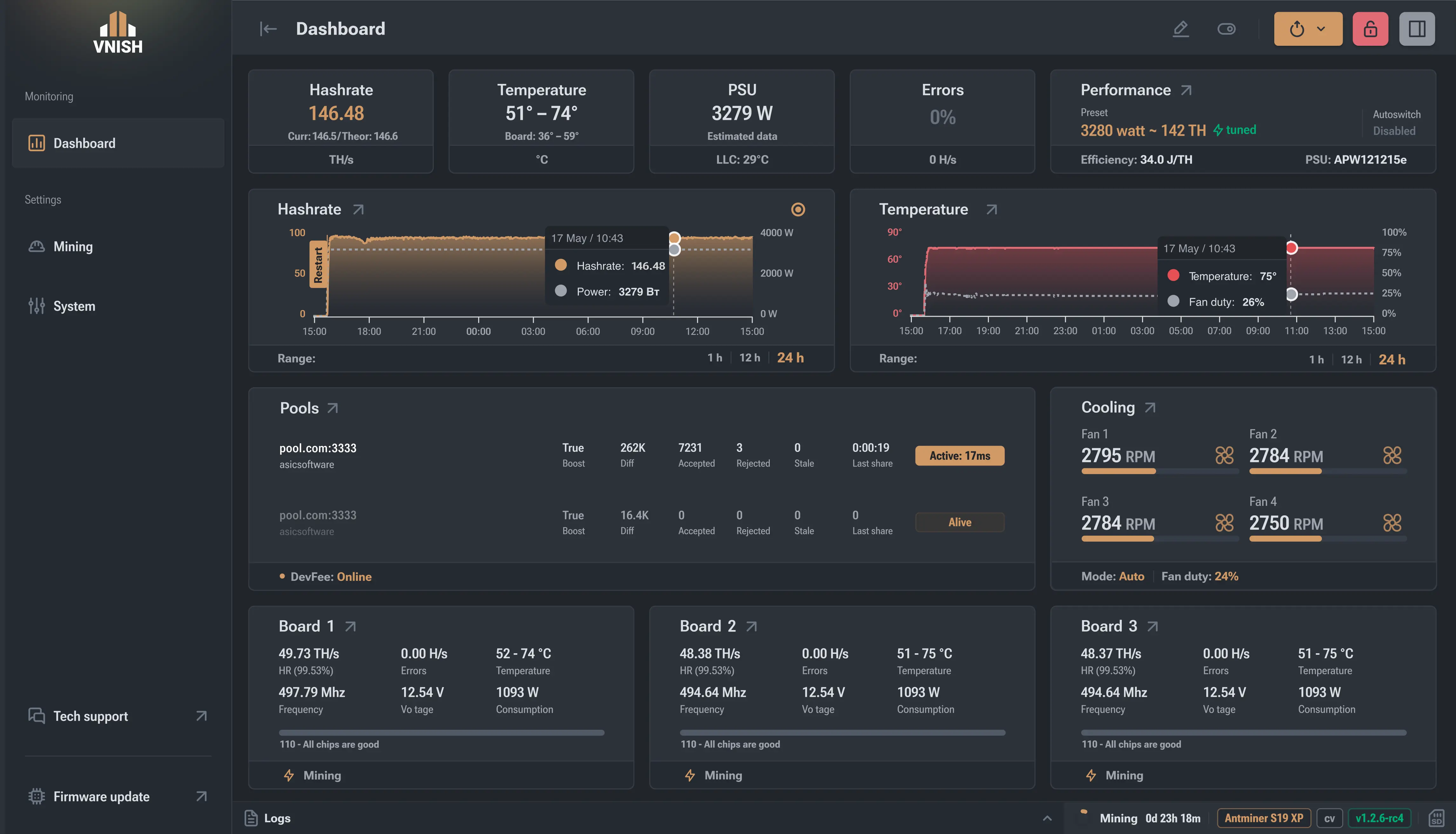
The VNISH interface is designed to be as simple and intuitive as possible, even for users without extensive technical experience. All settings are accessible directly through a standard browser, so there is no need to install additional software. Parameter changes can be made with a single click, which significantly speeds up the management process. In addition, VNISH provides detailed real-time statistics: the user can see the temperature, hashrate, power consumption and other important indicators, allowing them to respond quickly to any changes. Thanks to this, even large farms with a large amount of equipment can be maintained without unnecessary effort and time.

Safety System
VNISH has built-in multi-level security systems that ensure stable and secure operation of miners in various conditions. If the equipment temperature exceeds the permissible limits, the firmware automatically stops the device, preventing overheating and possible failure of chips or power supply boards. In addition, protection against incorrect voltage is implemented: if the power supply exceeds safe values, the system blocks operation and signals a problem. All this together allows you to experiment with profiles and operating modes without fear of damaging the miner, because any critical scenario is controlled and stopped in a timely manner by the firmware.

Hashrate Boost up to 20%
VNISH allows you to significantly increase the hashrate thanks to the auto-tuning system. The firmware works with each individual element of the hash board, analyses the characteristics of the chips and selects the optimal voltage and frequency parameters for them. This individual approach allows you to achieve greater performance without losing stability. In addition, VNISH provides special overclocking profiles that the user can apply depending on the task: when maximum computing speed is required, simply activate the appropriate profile and the miner will switch to high hashrate mode. This feature is especially useful during periods of high BTC prices, when each additional terahash can bring significantly more profit.
Supported models ASIC miner
VNISH firmware supports a wide range of ASIC miners, including the most popular Antminer models.
Antminer S19 is the base model of the series, built on 7nm chips. In its stock configuration, it runs stably but with higher power consumption. Thanks to VNISH, this model can be made more economical or, conversely, overclocked for additional performance.
The Antminer S19j Pro offers an improved balance between speed and power consumption. Using VNISH allows you to increase its stability and get a noticeable increase in hashrate or significantly reduce consumption in energy-efficient mode.
The Antminer S19XP runs on more modern 5nm chips, which already provide good efficiency. After optimisation with VNISH, this model can become even more economical or achieve higher performance in overclocking modes.
The Antminer S21 is considered the most efficient of its generation. Even in standard settings, it has a high level of energy efficiency, but with VNISH, users can further reduce costs or increase performance based on their tasks and conditions.
In addition, VNISH supports a number of other models, such as Antminer L7 and Antminer L9, which work with the Scrypt algorithm. The effect is also noticeable here: you can achieve energy savings of 10–15% or get additional megahashes.
Effect by chip class.
- 7 nm chips (S19) - optimisation allows you to reduce W/TH.
- 5 nm chips (S19XP, S21) - better stability and finer tuning, allowing for even greater effect.
- Scrypt models (L7, L9) - temperature control is especially important as they heat up more.
Getting started in minutes
One of the advantages of VNISH firmware is its ease of installation. Even an inexperienced user can install the firmware in less than 10 minutes.
Backup & install
Before installation, it is recommended to make a backup copy of the settings. It is important to write down or save the addresses of your pools and authorisation data in advance so that after the update you can quickly reconnect to the necessary services without additional searches. Then the user downloads VNISH from the official website and installs it using the HashCore Toolkit. The user opens the programme, selects the desired device from the list of miners found on the network, adds the firmware file and starts the update. All actions are performed centrally and take a few minutes, even for a large group of devices. After restarting, the device will be running on the new firmware.
If necessary, VNISH can be installed via an SD card, which is especially convenient for devices that do not boot correctly.
First run: autotune, fan curve
When first launched, VNISH performs auto-tuning of the chips. This means that the firmware tests each chip, determines its stable frequency and voltage range, and creates an optimal profile. This also happens after installing a new overclocking profile.
Одновременно формируется кривая вентилятора - зависимость скорости вентилятора от температуры. Благодаря этому майнер сразу работает стабильно, без перегрева и чрезмерного шума.
Rollback plan
VNISH always provides the option of rollback. The user can return the device to the stock firmware or a previous version at any time, if necessary. This can be done using the HashCore Toolkit, which is especially convenient when working with large farms. This provides additional security and confidence that the equipment can always be restored to a proven state.
Tools for fleets: HashCore Toolkit
For small mining installations, a web interface is sufficient. But when it comes to farms with hundreds or thousands of devices, centralised tools are required.
HashCore Toolkit is software that works in conjunction with VNISH firmware and allows you to:
- Scan the network. Find all miners on the local network;
- Group devices. Combine miners into groups for convenient management;
- Update firmware en masse. Install or update VNISH on dozens of devices at once;
- Configure profiles. Apply the same configurations to a group of miners;
- Monitoring. Track temperature, hashrate, W/TH, and failure statistics in real time;
- Вести логи и экспортировать данные, а также хранить их для последующего анализа и составления отчётов.
In addition, HashCore Toolkit supports centralised rollback to stock firmware, allows you to change pool addresses for an entire group of miners at once, and has tools for remote equipment restart. This functionality significantly reduces farm maintenance time, lowers the load on the administrator, and increases the stability of the entire infrastructure.
ASIC Profitability Calculator ASIC
Mining is a business where accurate calculations determine success. Even minor changes in W/TH or electricity rates can completely change profitability.
The ASIC Profitability Calculator allows you to quickly assess the profitability of your equipment under different conditions. The user enters three basic parameters: hashrate, power consumption, and the cost per kilowatt-hour in their region. The system then instantly calculates the expected income, electricity costs, and net profit. The results are displayed in a convenient format for one day, one week, and one month, which helps you understand how profitable the equipment will be in the short and long term.
Why is it important to change W/TH?
If a device operates at 32 W/TH at a rate of 0.1 USD/kWh, and the user reduces the figure to 28 W/TH, the difference in costs is several hundred dollars per year per miner. For a farm with 200 devices, this amounts to tens of thousands of dollars.
Pricing & terms
VNISH firmware has a transparent usage system with no hidden costs. The firmware operates on a dev fee model of 2.8%. This means that during the miner's operation, a small portion of the time is given to the developers, and the rest of the time the equipment works exclusively for the benefit of the owner.
This approach avoids additional payments, subscriptions or separate licence fees. The user gets the full functionality of the firmware regardless of the mode selected, whether it is energy efficiency or maximum overclocking. In addition, access to updates and new features is automatically included in this percentage, making the system understandable and predictable.
Flexible terms
Owners of large farms can negotiate corporate terms. This is especially beneficial for those who have hundreds or thousands of miners. In such cases, the cost per device is significantly reduced.
FAQ
What is ASIC mining?
What is ASIC mining firmware?
This is software that replaces the miner's factory firmware. It allows you to gain more control over the device, optimise it for specific conditions and increase efficiency.
Can VNISH improve ROI and how?
Yes. ROI (return on investment) directly depends on electricity costs. If VNISH reduces W/TH by 10%, the payback period for the equipment can be reduced by several months.
How long has Vnish been in business?
The development of VNISH firmware began in 2016. Since then, it has been constantly updated and adapted to new generations of equipment.
Where is Vnish based?
Vnish is an international team of developers and engineers who collaborate with farms in different countries.